
AI Business Brain Foundation
Build the business brain before you build the bot.
Before AI can write, respond, sell, or support your business, it needs to understand your services, voice, offers, customers, policies, and standards. The AI Business Brain Foundation turns your scattered knowledge into a structured, AI-ready second brain.
AI-assisted. Human-reviewed. Built around your real business context.
The problem
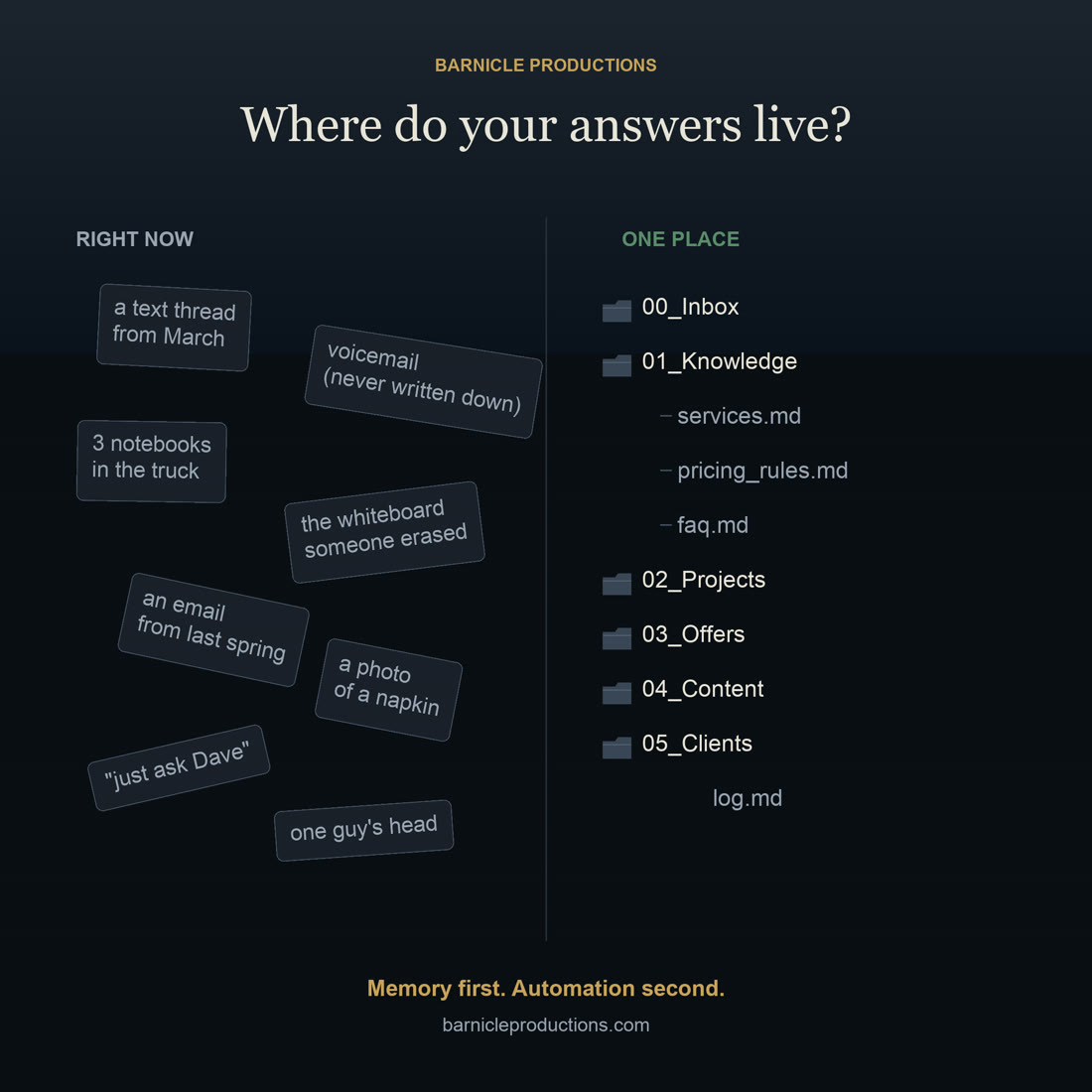
Your business already has the answers. They are just scattered.
Your best explanations are in old emails. Your pricing logic is in your head. Your job photos are in folders. Your FAQs are spread across texts, calls, reviews, proposals, and your website.
That scattered knowledge makes it harder to:
- Train staff
- Reply consistently
- Create content
- Build useful AI workflows
- Delegate decisions
- Follow up quickly
- Keep your brand voice consistent
AI can help, but only after the business knowledge is organized.
What we build
A private, practical second brain for your company
We collect, structure, and refine the information your business uses every day:
- Business profile, services, and offers
- Pricing logic and boundaries
- Customer types, FAQs, and objections
- Brand voice and communication standards
- Approved claims and proof
- Scheduling and availability rules
- Media asset map
- Sales process, approval, and escalation rules
- Workflow roadmap
Once the business brain exists, it can support lead response drafts, customer email replies, content creation, proposal generation, website updates, team training, SOPs, reporting, CRM notes, and internal decision support. Without it, AI guesses. With it, AI has context.
How it’s organized
Five layers, from the map to the day’s work.
The structure is what makes the brain usable — by your team and by AI. Each layer answers one question, so nothing has to read everything to do anything.
One short guide to the whole system — what lives where, and the rules that never change.
A simple index that points each task to the right place — and just as important, what to skip.
Each kind of work gets its own space with its own instructions: leads, content, proposals, operations.
Your voice, offers, boundaries, and approved claims — written once, applied to every draft.
The current job: this week’s leads, this proposal, this batch of photos. Always kept separate from the standards.
See it in use
I run this architecture on my own work first.
My private source-intelligence system sits upstream of separate business, client, creative, and research workspaces. I show what is operational today, what stays manual by design, and what I am still building toward.
Process
Five steps from scattered to structured
-
Audit
We review where your knowledge lives now.
-
Extract
We pull knowledge from conversations, documents, website copy, media, proposals, and owner interviews.
-
Structure
We organize it into an AI-ready second-brain system.
-
Refine
We turn messy notes into usable rules, examples, and communication standards.
-
Roadmap
We identify the highest-value AI workflows to build next.
Best fit
This is built for businesses that…
- Want to use AI but do not know where to start
- Have valuable knowledge trapped in the owner’s head
- Need more consistent communication
- Want better content from existing work
- Are preparing for lead automation or CRM improvements
- Want a durable business asset, not a one-off chatbot
Demo application: Field-to-Proposal
One workflow, end to end — in a glass box.
Field-to-Proposal shows what a business brain makes possible: a draft-first workflow that turns a job walkthrough into a proposal-ready draft. It is a downstream application of the Foundation — and a glass box: at every stage you can see what went in, what context was used, and why the draft says what it says.
-
Capture
Walk the job the way you always do. Field notes, photos, and voice memos are the only new input.
-
Recall
The business brain supplies your context: services, materials logic, past proposal language, and the boundaries you have set.
-
Draft
AI assembles a proposal draft from the walkthrough plus your real business knowledge — in your language, not boilerplate.
-
Review
You see the inputs, the context, and the draft side by side. Edit or approve — nothing is sent without you.
-
Send
The approved proposal goes out while the walkthrough is still fresh.
AI-assisted. Human-reviewed. Built around your real business context.
Start here
Start with the foundation.
Request the free AI & Operations Audit and we will map what your company needs to organize before automating.
Book a call
Book a free audit callPick a time on Monday, Wednesday, or Friday morning — you will get a calendar invite with a video link. “Just curious” is a fine reason to book.
New to this? Start with why AI keeps making things up about your business — the problem this is built to solve.
Questions first? The FAQ covers what these systems are, how automation stays safe, and where to start.
Prefer email? info@barnicleproductions.com