
The Content Machine
Content that sticks. Made by a machine you can see inside.
Most content operations are a person and a blank page, every week, forever. The Content Machine replaces the blank page with a process: raw material goes in one end — notes, transcripts, voice memos, client answers, the things you already said out loud — and finished, on-brand content comes out the other. It is not a subscription to a tool. It is a documented system, built around your business, that you keep.
01 The problem
You are not short on ideas. You are short on a process.
The raw material for a year of content already exists. It is in the transcript of the walkthrough you did last Tuesday, in the four questions every customer asks before they buy, in the photos on your phone from the job you just finished, in the email where you explained your whole approach better than your website does.
What is missing is the machinery between that material and a finished post. So content gets made the expensive way: from scratch, under time pressure, by whoever is free, in a voice that drifts a little each time. It works until the week it does not, and then it stops for a month.
Buying a writing tool does not fix this, because the tool is not the missing part. The missing part is the structure around the tool — where raw material lands, how it gets processed, what the brand rules are, which output goes where, and who checks it before it ships.
02 The machine
Six stages, one closed loop.
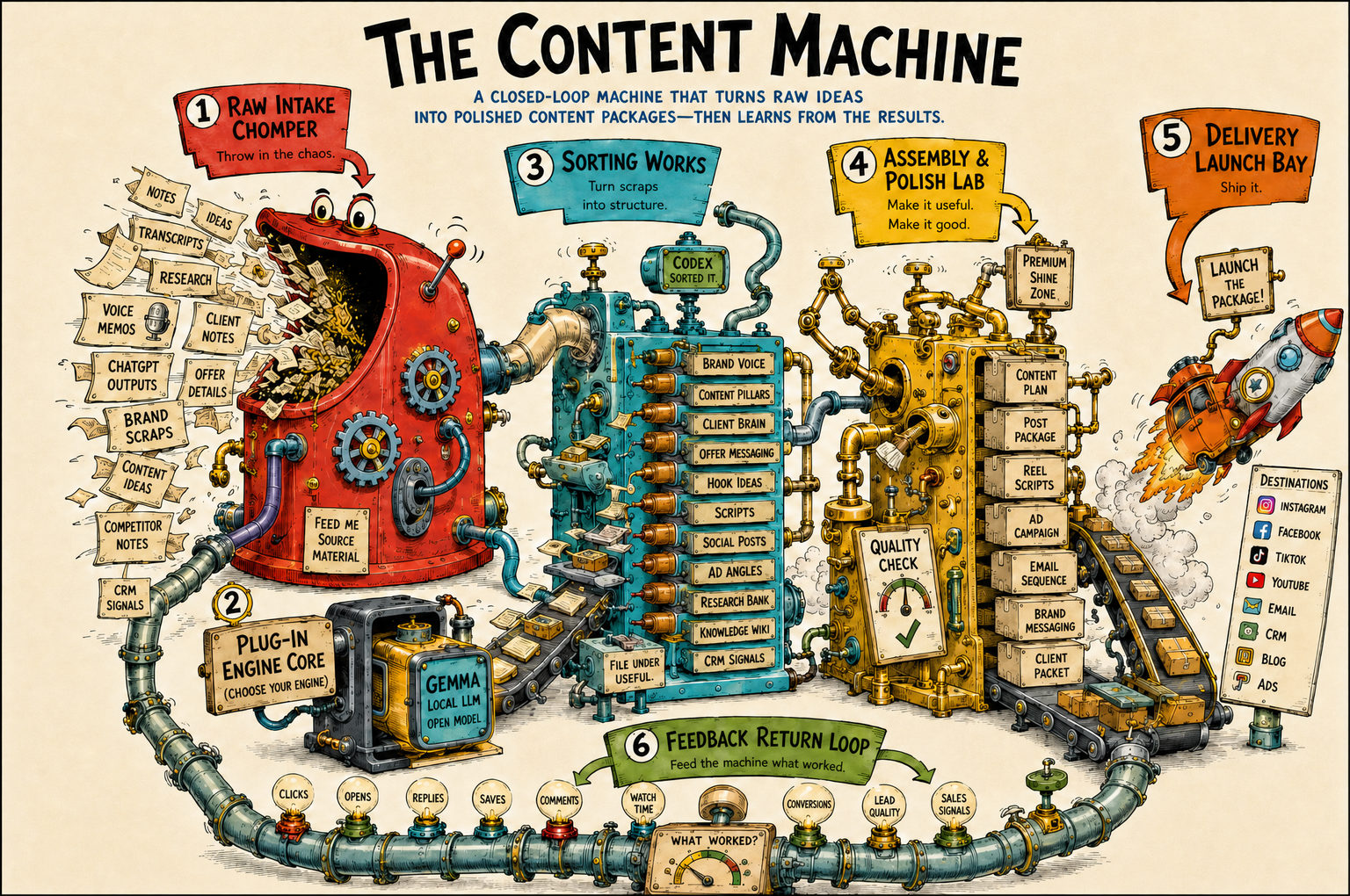
Raw material goes in at one end. It gets sorted into the parts a brand is actually made of, assembled into packages, and shipped to the places you publish. Then what worked comes back around as input for the next batch.
03 The stages
Every stage in the drawing is a folder you can open.
Open one and you can see exactly what happened: the source material it drew on, the rules it followed, and what it produced.
-
01
Raw Intake
00_Inbox_Raw/
One place where messy material lands and is allowed to stay messy: transcripts, meeting notes, voice memos, client answers, competitor notes, half-finished ideas. Nothing is required to be tidy at this stage. The single rule is that it goes in the inbox instead of staying in your head, your texts, or a document nobody can find.
-
02
Plug-In Engine Core
_CONFIG/model_routing.md · 08_Local_Model_Workflows/
The model is a part, not the machine. Cheap repetitive work — cleaning transcripts, tagging, first-pass extraction — can run on a local open-weight model on your own hardware. Judgment work — brand voice, positioning, final polish — goes to a frontier model. Which task goes where is written down in a routing file, so it is a decision you can see and change rather than a habit.
-
03
Sorting Works
01_Processed_Sources/ · 02_Client_Brains/ · 03_Content_Strategy/
Raw material becomes structured source files, and those connect to the brand’s own truth files: voice, offers, audience, objections, approved claims, language to avoid. On top of that sit the strategy layers — content pillars, hook banks, campaign briefs, calendars. This is the layer that makes output sound like you instead of like a chatbot, and it is the layer most content tools skip entirely.
-
04
Assembly & Polish Lab
04_Post_Generators/ · 05_Ad_Generators/
Named generators build the actual drafts — social posts, reel scripts, carousels, blog outlines, newsletters, ad angles, landing-page sections, objection responses. Each generator is a written framework rather than a one-off prompt someone typed once and lost, so the same input produces comparable output next month and the month after.
-
05
Delivery Launch Bay
06_Output/
Finished work is packaged per destination — a post package, a reel script set, an email sequence, a campaign package, a client packet — with the caption, the hook, and the supporting copy together instead of scattered. Publishing stays a human action. The machine gets it to the edge, ready to go, and a person presses the button — you, or us if you take the managed option.
-
06
Feedback Return Loop
07_Reports/
What actually worked goes back in as source material: which hooks earned attention, which offers drew replies, which questions kept coming up. Every batch also leaves a report behind — what was used, what was produced, what was assumed, what still needs review — so the system accumulates a memory of its own decisions rather than starting fresh each time.
04 What it actually is
A folder of plain text files. That is the whole product.
The Content Machine is a directory on your drive. A folder for each stage, written instructions the AI has to follow, named generators, skill files for each repeatable process, and a config folder holding the rules — your taxonomy, your naming conventions, your quality standards, your model routing.
Plain text has properties a clever tool does not. You can read it. You can change it without asking anyone. It works with whichever model is best in a year, because the instructions are not welded to a vendor. And it survives us — if you stop working with Barnicle Productions, the machine goes with you and keeps running.
What makes it work is that the process is written down: plan, execute, review, refine, repeat. The same way every time, instead of depending on who is having a good week.
The machine, actual size
content_engine/
  00_Inbox_Raw/         messy in
  01_Processed_Sources/ structured
  02_Client_Brains/     your truth
  03_Content_Strategy/  pillars
  04_Post_Generators/   organic
  05_Ad_Generators/     paid
  06_Output/            finished
  07_Reports/           what changed
  08_Local_Model_...    cheap work
  09_Tools/             scripts
  _CONFIG/              the rules
  _Prompts/             the asks
  _Skills/              the how
  AGENTS.md             the brief
05 Choose your engine
The folder system is the machine. The model is the part you can swap.
Running everything through one expensive model is how content systems get costly and brittle. The routing is written into the system as a file, so the cheap work goes somewhere cheap and the work that needs judgment goes somewhere good.
| Task | Where it runs | Why |
|---|---|---|
| Transcript cleanup | Local open-weight model | Cheap, repetitive, low risk if it is imperfect |
| Source extraction | Local open-weight model | Good enough for a structured first pass |
| Tagging and classification | Local open-weight model | High volume, low judgment |
| Brand voice | Frontier model | Nuance, and the cost of getting it wrong |
| Offer and positioning | Frontier model | Synthesis, not retrieval |
| Final polish | Frontier model | Taste and language quality |
| Scripts and file operations | Coding model | File-aware, and it can be tested |
One more rule, and it is not optional: anything a local model produces gets reviewed before it goes near a customer. Cheap first passes are cheap because they are first passes.
06 What you get
A working machine, not a document about one.
- The folder system, installed
- The full directory structure with every stage in place, dropped into a repo or vault you own. Not a template you have to interpret — the working thing, with your material already flowing through it.
- Your brand brain
- The truth files the whole system reads from: brand voice, offer map, audience map, content preferences, and an approvals-and-claims file recording what you are actually allowed to say. That last file is the one that keeps AI-assisted content out of trouble.
- The generators
- Written frameworks for the formats you actually publish — social posts, reel scripts, carousels, blog outlines, newsletters, ad angles, landing-page sections, objection responses — tuned to your voice rather than generic.
- The operating instructions
- The files that tell any model how to behave inside your system: the agent brief, the model-specific instruction files, the skill files for each repeatable process, and the config that holds naming conventions, taxonomy, and quality standards.
- A first batch, run with you
- We do not hand over an empty machine. We run a real batch together — one source, one audience, real output — so you have seen the loop close once before you are doing it alone.
- The reports
- Every batch leaves a record: sources used, output produced, assumptions made, claim risk flagged, what needs review. When something reads wrong three months from now, you can find out why.
07 The quality gate
The check is written down, so it is not a matter of mood.
Every piece of output passes a standing checklist before it counts as finished. It lives in the system as a file, which means it applies whether the draft came from a model, from us, or from you at eleven at night.
Content
- A clear audience
- A real opening hook
- A specific source behind it
- No unsupported claim
- No invented testimonial
- No manufactured urgency
Strategy
- Tied to an actual offer or goal
- Fits a stage of the funnel
- Has a next step
- Makes sense for the platform
Writing
- Concrete language
- Specific nouns and verbs
- No corporate mush
- Empty intensifiers removed
- The human texture kept
Flagged, not buried
- Source confidence
- Claim risk
- Brand voice fit
- Missing information
- What to review next
08 Scope
What this is and is not.
This is a content production system: intake, source processing, brand truth files, strategy layers, generators, packaged output, QA, and the reports that track it. It runs best on top of an AI Business Brain, because the brand truth files are the same truth files, and it produces better-looking work when there is a brand system underneath it. Neither is a prerequisite. We can start here.
The machine itself does not publish. It gets work to the edge and a person presses the button, so nothing goes out under your name without someone approving it. That person can be you, or it can be us.
One boundary worth stating plainly: the machine owns briefs, strategy, scripts, hooks, captions, and packages. It does not become the home for your raw footage or your approved video masters. Those stay where they belong, and the system points at them rather than swallowing them.
09 Or we run it
Take the keys, or hand them back to us.
Some owners want the machine and want to run it themselves. Others want the machine to exist and want somebody else operating it. Both are real answers, and the second one is a full service rather than a lesser version of the first.
The operating side runs inside a GoHighLevel workspace, white-labeled under Barnicle Productions — one place where published content, inbound conversations, and reporting all live together. Your Facebook page, Instagram account, and Google Business Profile connect into it. Replies land in a single inbox instead of four apps. The numbers come back to one dashboard instead of being chased down platform by platform.
That is also what closes the loop properly. Stage six only works if somebody is genuinely looking at what happened — which hooks earned attention, which offers drew replies, which posts went nowhere. On the self-run tier, that somebody is you. On the managed tier it is us, and what we find goes back into the brand truth files and the generators, so the next batch is built on evidence instead of instinct.
Two things do not change. You still own every account, every asset, and the machine itself — we operate them, we do not hold them, and you can take the whole thing back at any point. And publishing still passes a human before anything goes out under your name.
What we operate
- The content batches themselves, on a set rhythm
- Publishing to your connected accounts
- Facebook, Instagram, and Google Business Profile
- One inbox for replies and inbound messages
- Reporting on what the published work actually did
- Those findings fed back into stage six
Your accounts, your assets, your machine. We hold the controls, not the keys.
10 Next step
Bring one transcript and one question.
The fastest way to see whether this fits is to run the smallest real version of it: one piece of source material you already have, one audience, one output type. Bring a recording, a walkthrough, or the email where you explained your work best, and we will show you what comes out the other end. Whether you end up running the machine yourself or having us run it is a decision for later, not for the first call.